

Project at a glance
A large portion of the vacation rental market is highly fragmented because many private landlords rent out just one or two units. Unlike major vacation rental providers such as Reka or interhome, they have limited options when it comes to pricing because they lack comparative data. As a comparison of vacation rental markets in several regions within Switzerland and in neighboring countries has shown, pricing tools (e.g., early-bird discounts, off-season discounts) are used much more frequently for vacation rentals abroad.
To improve pricing and rent out more second homes, new landlords in particular—but also existing ones—need support from tourism organizations. So far, these organizations have been unable to provide reliable reference prices, which is a source of frustration for landlords. Due to a lack of experience, existing landlords are hesitant to adjust prices and tend to base their rates on prevailing local prices.
In this project, we aim to develop a tool that provides guidance on pricing vacation rentals. This guidance should cover both the timing of price setting and the price level. In addition, the tool will enable price comparisons for vacation rentals across Switzerland. This will provide tourism organizations with a tool that is currently lacking. Furthermore, it will enable them to provide more informed guidance to vacation rental owners and help optimize value creation within the destination.
To achieve these results, we plan to analyze current booking data in the second work package of the project proposed here. For this purpose, we will collect all necessary data in Work Package 1. This analysis will help us understand the factors that influence prices. Additionally, the analysis will allow us to conduct price comparisons at the Swiss level based on apartment characteristics and locations. In this context, we will gain an understanding of current rental trends and determine the optimal times to offer discounts. The timing and scope of discounts will be analyzed in greater depth in Work Package 3 using behavioral pricing. Based on these results, Work Package 4 will develop a tool that provides landlords with pricing recommendations. Additionally, the tool will allow landlords to make comparisons. This is intended to help ensure a more economical use of the apartments and thus improve overall occupancy rates across the region. The project is scheduled to run from March 2024 through fall 2026. All participants are motivated to contribute to the project’s development.
Project
Analysis of Pricing for Vacation RentalsLead
Institute for Data Analysis, Artificial Intelligence, Visualization, and Simulation (DAViS) More about Institute for Data Analysis, Artificial Intelligence, Visualization, and Simulation (DAViS)Project Leader
Staudt Yves More about Staudt YvesInvolved parties
Touristika GmbH
University of Applied Sciences of Graubünden
Lucerne University of Applied Sciences and Arts
Heidiland Tourism
Gstaad Saanenland Tourism
Toggenburg Tourism
Lenk-Simmental Tourism AG
Ente Turistico del Luganese
MyLeukerbad
Engadin Tourism AG
Destination Davos Klosters
TALK (Adelboden-Lenk-Kandersteg Tourism) AG
Saastal Tourism AG
Jungfrau Tourism AG
Aletsch Arena AG
HHD AG
feratel Switzerland AG
TOMAS
e-domizil AGTeam
Keller Thomas More about Keller Thomas Lindau Sabrina More about Lindau Sabrina Rölke Heiko More about Rölke Heiko Schmid Marco More about Schmid MarcoResearch fields
AI for structured and unstructured Data More about AI for structured and unstructured Data Computational Science for Simulation and Optimization More about Computational Science for Simulation and Optimization Visualization and Dashboards More about Visualization and DashboardsFunding
InnotourDuration
March 2024 – October 2026
Background
To improve pricing and rent out more vacation homes, new landlords in particular—but also existing landlords—need support from tourism organizations. However, these organizations have so far been unable to provide reliable reference prices, which is a hindrance to landlords. Due to a lack of experience, landlords show little willingness to adjust prices and usually base their rates on the standard regional price level.
To improve the situation, the project will analyze current booking data to identify factors influencing pricing and enable price comparisons across Switzerland based on property and location characteristics. This will provide a better understanding of the current rental situation and allow for the identification of optimal times to offer discounts. The timing and scope of such discounts will also be examined as part of an in-depth analysis of “behavioral pricing.”
Project objective
The project aims to develop a tool that provides landlords with sound guidance on pricing their vacation rentals. This guidance is intended to cover both the timing of price setting and the specific price level. In addition, the tool is designed to enable price comparisons for vacation rentals across Switzerland, thereby providing a much-needed resource for tourism organizations.
By using this tool, tourism organizations will be better equipped to provide information to property owners and help increase value creation in the destinations. At the same time, the tool helps property owners make more economically sound decisions, which in turn lead to better occupancy rates across the entire region.
Interim results
Using booking data and property characteristics from the twelve partner destinations, as well as from the providers Interhome and E-Domizil, an AI model was used to analyze sales patterns and, based on this analysis, generate price forecasts for the future. The models identify both regional and supraregional correlations. This allows insights—for example, regarding 3.5-room apartments in Davos—to be applied to St. Moritz or the Jungfrau region as well.
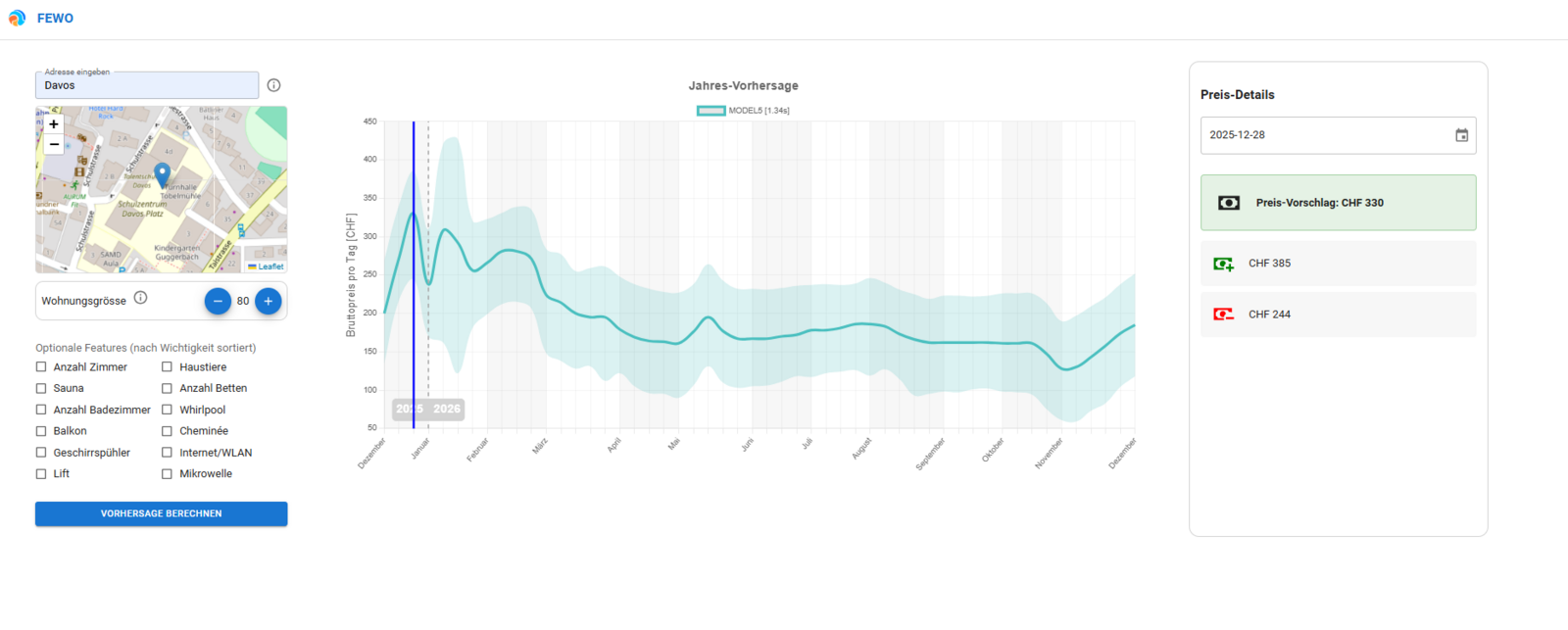
Since prices and forecasts are naturally subject to fluctuations, the recommended prices are presented as a range with upper and lower limits. We recommend that landlords set their prices within this range. The model also takes seasonal variations into account.
Results
Our current tool is available at fewo-check.fhgr.ch and can be tested for free. Since pricing depends heavily on location, users first select the vacation rental’s location—either by entering the address or by pinpointing it on the map.
Users can then customize additional apartment features. If no adjustments are made, the predefined default settings remain in effect. Clicking «Vorhersage berechnen» generates the price forecasts. These provide an annual outlook with a recommended price range consisting of a lower and upper limit.
Data is currently available through the end of 2025.





Ronnie Oehrli (touristika GmbH) is the project director, and Prof. Dr. Yves Staudt (FH Graubünden) is the co-project director.
Previous projects have also been supported by the following companies:
- Touristika GmbH
- Lucerne University of Applied Sciences and Arts
- Heidiland Tourism
- Gstaad Saanenland Tourism
- Toggenburg Tourism
- Lenk-Simmental Tourism AG
- Lugano Tourism Board
- MyLeukerbad
- Engadin Tourism AG
- Destination Davos Klosters
- TALK (Adelboden-Lenk-Kandersteg Tourism) AG
- Saastal Tourism AG
- Jungfrau Tourism AG
- Aletsch Arena AG
- HHD AG
- feratel Switzerland AG
- TOMAS
- e-domizil AG