

Project at a glance
Reinforced earth is an artificially created slope that is reinforced with stabilizing inserts such as geogrids for greater stability. This project is investigating how the plastics used can be replaced by natural materials.
Project
Reinforced earth with wood wool: Howolis MurusLead
Institute for Building in the Alpine Region (IBAR) More about Institute for Building in the Alpine Region (IBAR)Involved parties
Lindner Suisse GmbH Füllemann Systeme AG More about the involvedResearch fields
Alpine infrastructure buildings More about Alpine infrastructure buildingsFunding
Innosuisse, Lindner Suisse GmbH, Füllemann Systeme AGDuration
2026 - 2029
Initial situation
Embankments and dams made of reinforced earth are a widely used and proven construction method in civil engineering and landscaping today. In this method, compacted soil bodies are provided with layers of reinforcement so that the soil can absorb tensile forces that it would not be able to bear on its own. In practice, geogrids are mainly used as reinforcement. In addition, geogrids are installed at the visible front of the structure to prevent fine material from trickling out and to protect the seeding or greening. Nowadays, both geogrids and geogrids are almost exclusively made of plastic, which is technically efficient but leads to plastic entering the soil and environment in the long term.

Project objective
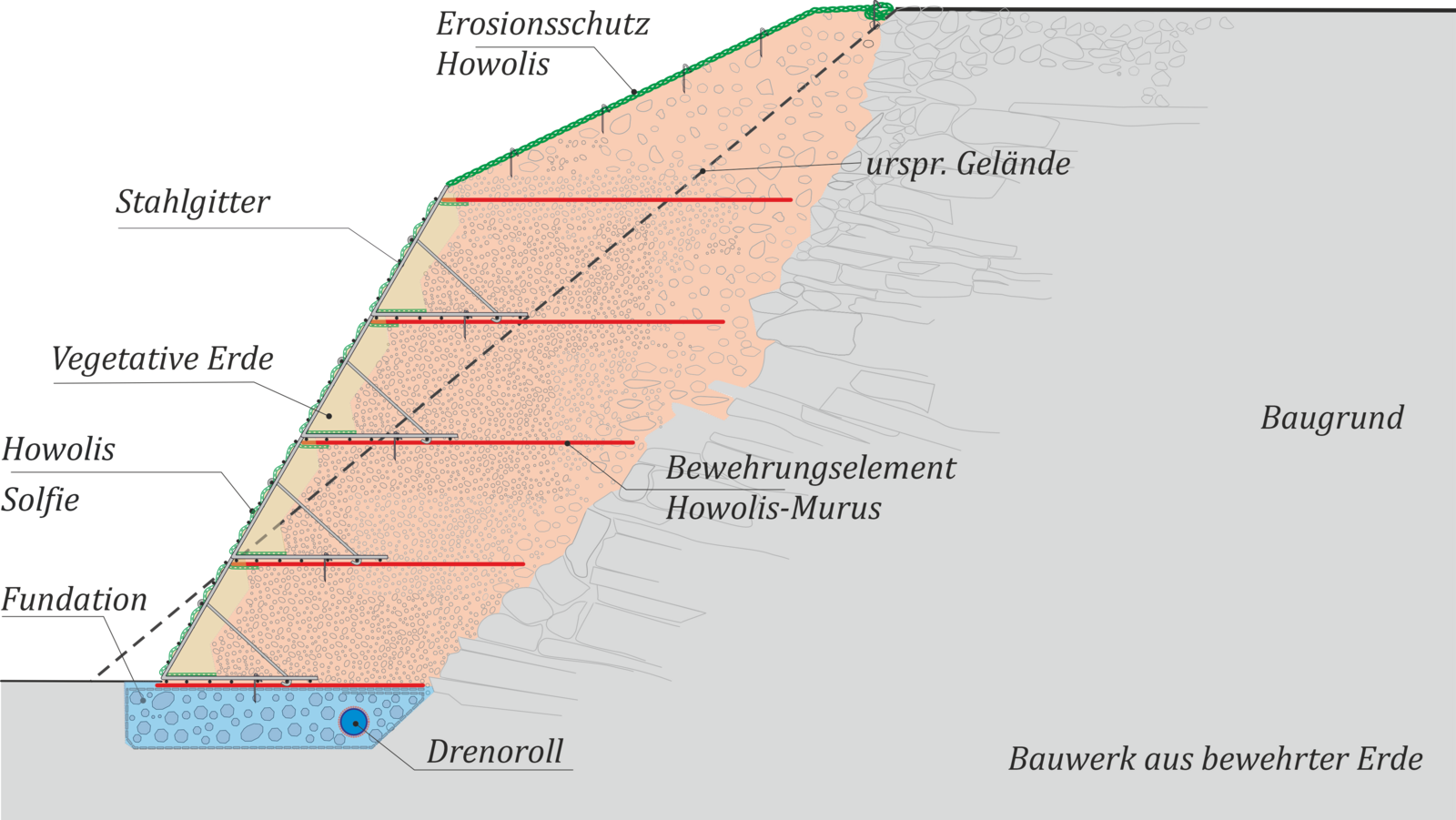
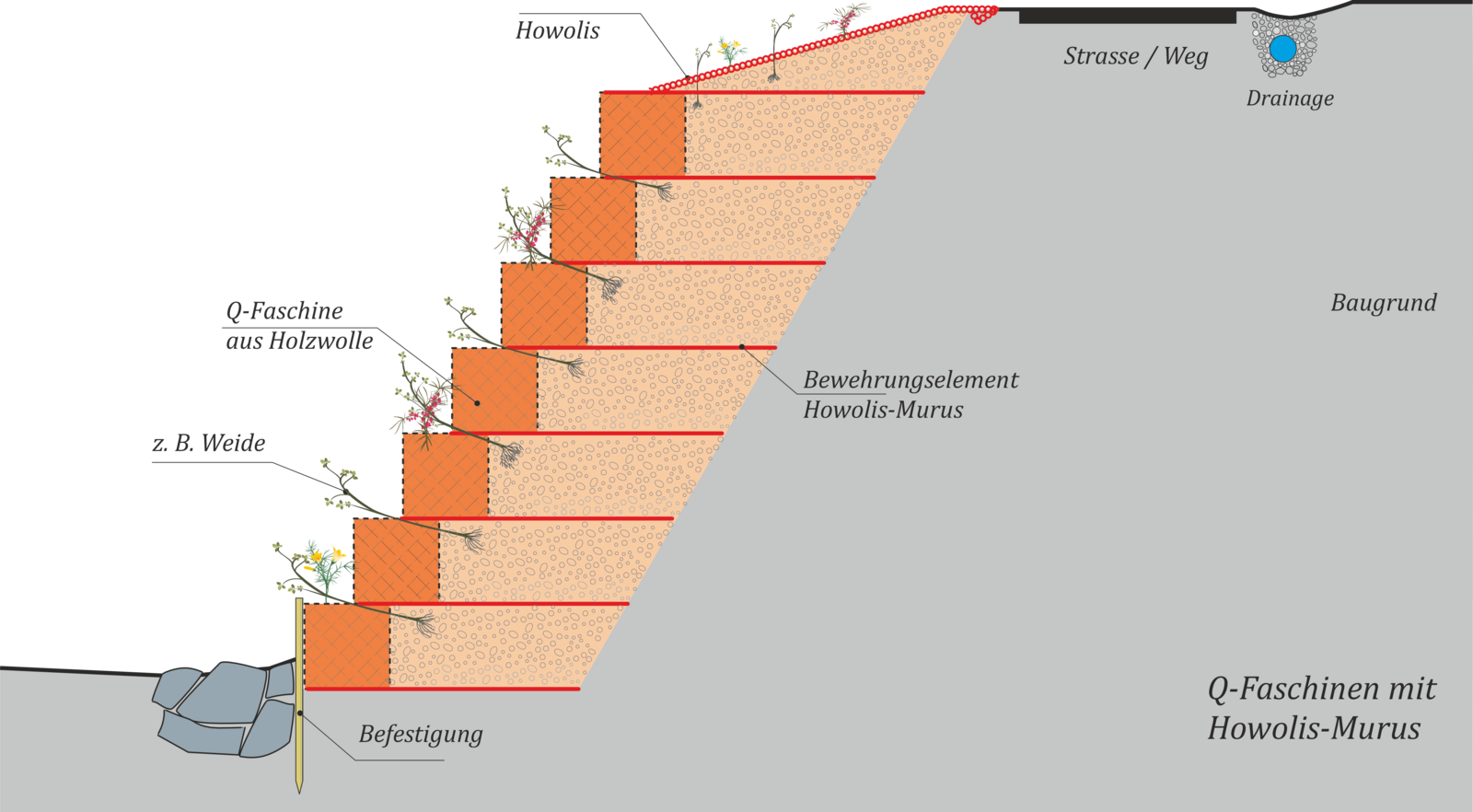
Previous research projects on wood wool fleece and wood wool fascines have shown that wood wool products function as erosion protection and greening carpet pad, provide support for cuttings and decompose in a controlled manner. Building on these findings, it is being investigated whether wood wool products can take over the functions of geogrids (new product name Howolis-Murus) and synthetic tangles (new product name Howolis-Solfi) in reinforced soil bodies. The aim is to develop a complete system that offers long-term stability and provides an ideal base for greening.
The newly developed products must also comply with the applicable standards and be suitable for practical use.
Implementation
The project pursues a practice-oriented approach. Newly developed prototypes for the Howolis-Murus reinforcement layer and the Howolis-Solfi erosion protection mat are being tested in the laboratory for their mechanical properties, weather resistance and handling.
Subsequent system tests in the laboratory will simulate the installation before two 1:1 scale support structures are built to test the system under real conditions. These pilot installations will be monitored over a longer period of time using various measuring instruments so that deformation, greening success and environmental parameters can be documented and evaluated.
The findings will be incorporated into practical installation recommendations and a final report. The aim is to provide a tried-and-tested, plastic-free system that offers long-term stability and a good basis for greening.


Participants
The project is being implemented by the Institute for Building in the Alpine Region (IBAR).