

Project at a glance
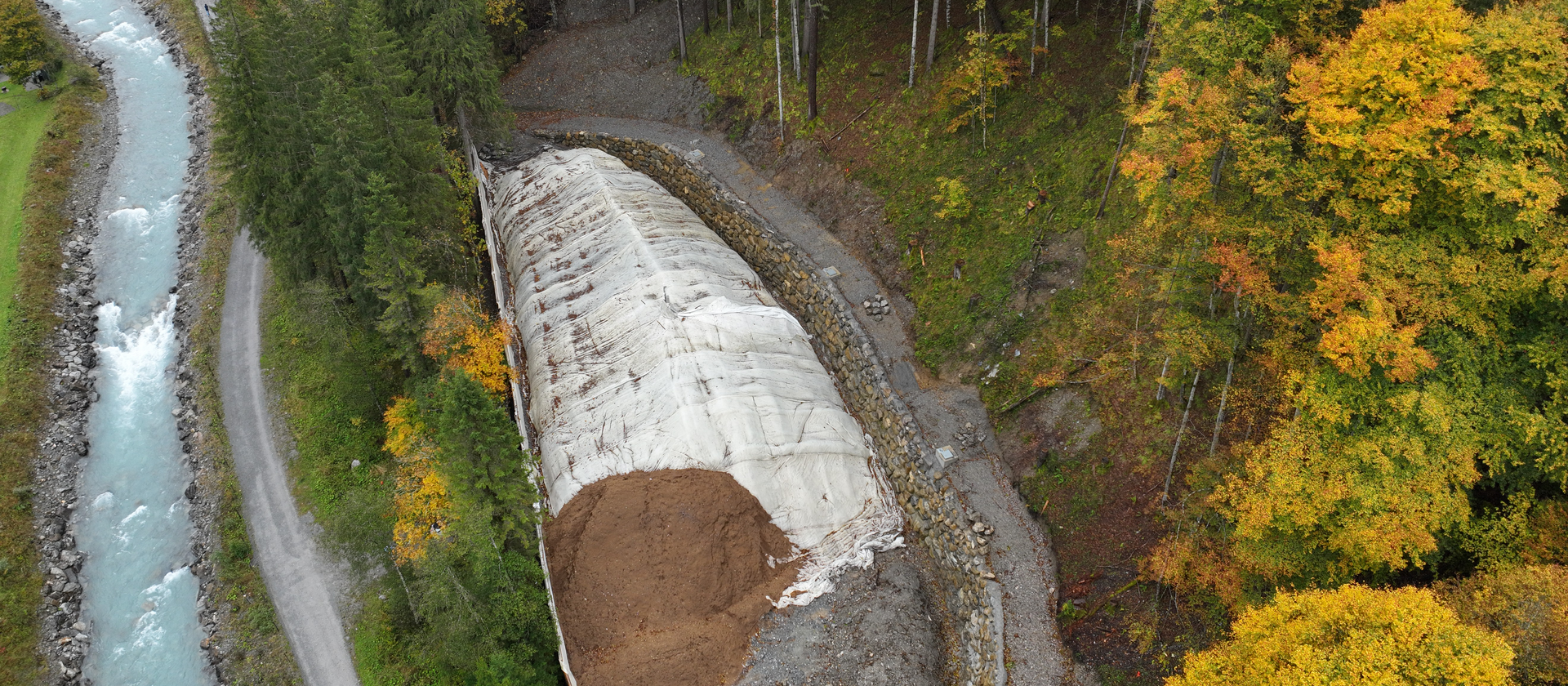
As part of an Innocheque project, the snowfarming project in Engelberg investigated how effectively a combination of Howolis wood wool fleece and Toptex GLS glacier protection fleece can insulate the snow during the summer. A pile of snow prepared for this purpose was photogrammetrically recorded at regular intervals in order to quantify its volume loss. Around 10 % of the snow pile was covered with sawdust, while the rest was covered with Howolis and Toptex-GLS fleece. A weather station recorded the meteorological conditions at the snow pile. In addition, the temperatures were measured at the layer boundaries of snow - insulation - surface. In addition, interviews were conducted with the operators of the snowfarming facilities in Engelberg and St. Moritz to analyze their experiences and the amount of work involved in using Howolis/Toptex GLS.
Project
Snowfarming with "Howolis"Lead
Institute for Building in the Alpine Region (IBAR) More about Institute for Building in the Alpine Region (IBAR)Involved parties
Lindner Suisse GmbH, Wattwil Fritz Landolt AG, Näfels Municipality of Engelberg Municipality of St. Moritz More about the involvedResearch fields
Applied glaciology More about Applied glaciologyFunding
InnosuisseDuration
April 2024 - January 2025
Initial situation
Snowfarming is a method of preserving snow over the summer so that it can be used to prepare slopes or cross-country ski trails in early winter. The great advantage of snow farming is that it ensures snow even when temperatures are too high for artificial snow production.
In snow farming, the snow produced in high winter or that has fallen naturally is pushed together at the end of winter to form a large deposit and covered with an insulating material. The more effectively the covering material insulates, the more snow is retained over the summer. As a rule, organic material such as wood chips or sawdust is used for covering, but non-organic materials such as polystyrene are also used less frequently. In recent years, the wood wool manufacturer Lindner Suisse GmbH has further developed the wood wool fleece "Howolis", which can be used as a covering material in combination with a robust glacier protection fleece "Toptex GLS" from Fritz Landolt AG. Its ability to insulate the snow pile has now been scientifically evaluated for the first time.
Project objective
The aim of the project was to find out how efficiently snow can be preserved over the summer with the combination of Howolis and Toptex GLS. To this end, a snow depot was monitored in Engelberg from mid-April to the end of October 2024, which was partly covered with Howolis/Toptex GLS and partly with sawdust. The data collected there was then compared with results from St. Moritz in order to better classify them.
Results
The results from Engelberg showed that the volume loss when using Howolis/glacier protection fleece was slightly greater compared to sawdust, but less than 10%. However, the Howolis/glacier protection fleece layer was significantly thinner than the sawdust layer. While 180m3 of solid wood would have been required to completely cover the snow pile with sawdust, the entire covering with Howolis would have required only 4.9m3, which corresponds to a proportion of 2.7%. In addition, the measurements showed that a significantly better result, i.e. less snow loss, would have been achieved if the layers had overlapped. It can therefore be assumed that if an additional layer of Howolis/glacier protection fleece had been applied, the result would have been significantly better.
It should also be mentioned that when sawdust is used, some of the snow is lost as it is mixed with sawdust. This is not the case with the Howolis design, as much less material remains in the snow.
At an altitude of just 1,000 m above sea level, the site in Engelberg is at the lower limit of altitudes in the Alpine region for the use of snow farming. The snow farming project in St. Moritz, located at 1,800 m above sea level, has achieved similar results in the last two years.
The surveys at both locations made it clear that spreading and removing howolis requires a lot of manual labor. Machine hours are replaced by man hours. This leads to a reduction in emissions, as fewer machines and therefore less fuel have to be used, but to a higher number of working hours overall.

The following former employee of the UAS Graubünden was involved in this project:
- Philip Crivelli
In addition to the employees of the UAS Grisons, the following people also participated in the project:
- Thomas Wildberger(Lindner Suisse GmbH)
- Walter Hurschler (Municipality of Engelberg)
- Arnold Denoth (Municipality of St. Moritz)
- Roger Tresch(Fritz Landolt AG)
Participants
The project is being implemented by the Institute for Building in the Alpine Region (IBAR).