

Project at a glance
Wood wool is made from various natural wood fibers. In a manufacturing process, the wood wool is processed into wood wool fleece, which is used to protect against erosion. The Institute for Building in Alpine Regions (IBAR) researched Howolis wood wool fleece as erosion protection. The aim of the research project was to reintroduce this old and proven application and to develop the technical basis for adapting this technique specifically to regional conditions (types of wood, adaptation to soil conditions). The potential of autochthonous, i.e. locally adapted, seed was also examined. The research project was subsidized by Innosuisse (formerly the Commission for Technology and Innovation CTI).
Project
Sustainable erosion protection with wood woolLead
Institute for Building in the Alpine Region (IBAR) More about Institute for Building in the Alpine Region (IBAR)Involved parties
Lindner Suisse GmbH, SUPSI-IST, Ö+L More about the involvedResearch fields
Alpine infrastructure buildings More about Alpine infrastructure buildingsFunding
Innosuisse (Commission for Technology and Innovation CTI)Duration
2015 - 2018
Initial situation
What is wood wool? Wood wool refers to wood fibers with a thickness of 0.05 to 2.5 mm and a width of 1 to 8 mm. Wood wool is a natural polymer. Like any material, it has advantages and disadvantages. Wood is hygroscopic because it can absorb moisture from the environment and release it again. Wood is inhomogeneous, anisotropic and biodegradable. Soft types of wood are primarily suitable for the production of wood wool, especially the softwoods spruce, silver fir, Scots pine and larch. Wood wool can also be produced from hardwoods such as copper beech, ash and poplar. To produce the wood fibers, the wood should be as knot-free as possible. It is best processed in a semi-moist state.
One area of application in the field of slope stabilization is the greening of open spaces.
However, wood wool was replaced in Europe decades ago by non-sustainable, cheaper plastic products and imported natural fibers. In cooperation with the two business partners Lindner Suisse GmbH and Ö+L GmbH, the UAS Graubünden has set itself the goal of re-establishing the necessary basic knowledge for sustainable erosion control - with wood wool and adapted seeds - in Switzerland and Europe.
To this end, the Swiss company Lindner Suisse GmbH offers products made from wood wool and marketed under the brand name "Howolis" (wood wool fleece). Howolis wood wool nonwovens consist of quilted combinations of wood wool from different types of wood and jute. Thanks to their good mechanical properties and biodegradability, they are well suited for soil protection and the greening of open spaces. Different wood wool formulations can be used to control the duration of the rotting process. Beech wood plays a central role in these formulations. In view of climate change with increasing heavy rainfall events, erosion protection using wood wool is an application with great potential.
Project objective
In our experiments, we wanted to test how well wood wool fleece works directly as erosion protection (by retaining material) and indirectly by facilitating greening and thus improving the growing conditions for seeds. The different wood wool fleeces and seed mixtures were compared under natural conditions. The effect of the wood wool nonwovens was tested using zero areas in which no wood wool mats were laid.
The following aspects were investigated over a period of several years in order to obtain information on the suitability and effect of the wood wool nonwovens:
- Behavior of the fleeces: Geometric changes (warping, shrinkage/swelling, change in length), visual changes (degradation processes of the wood fibers and the mesh), rotting process of the fleeces, strength tests in situ or in the laboratory
- Growth success of the seed: degree of cover, species composition, biomass, rooting depth
Implementation
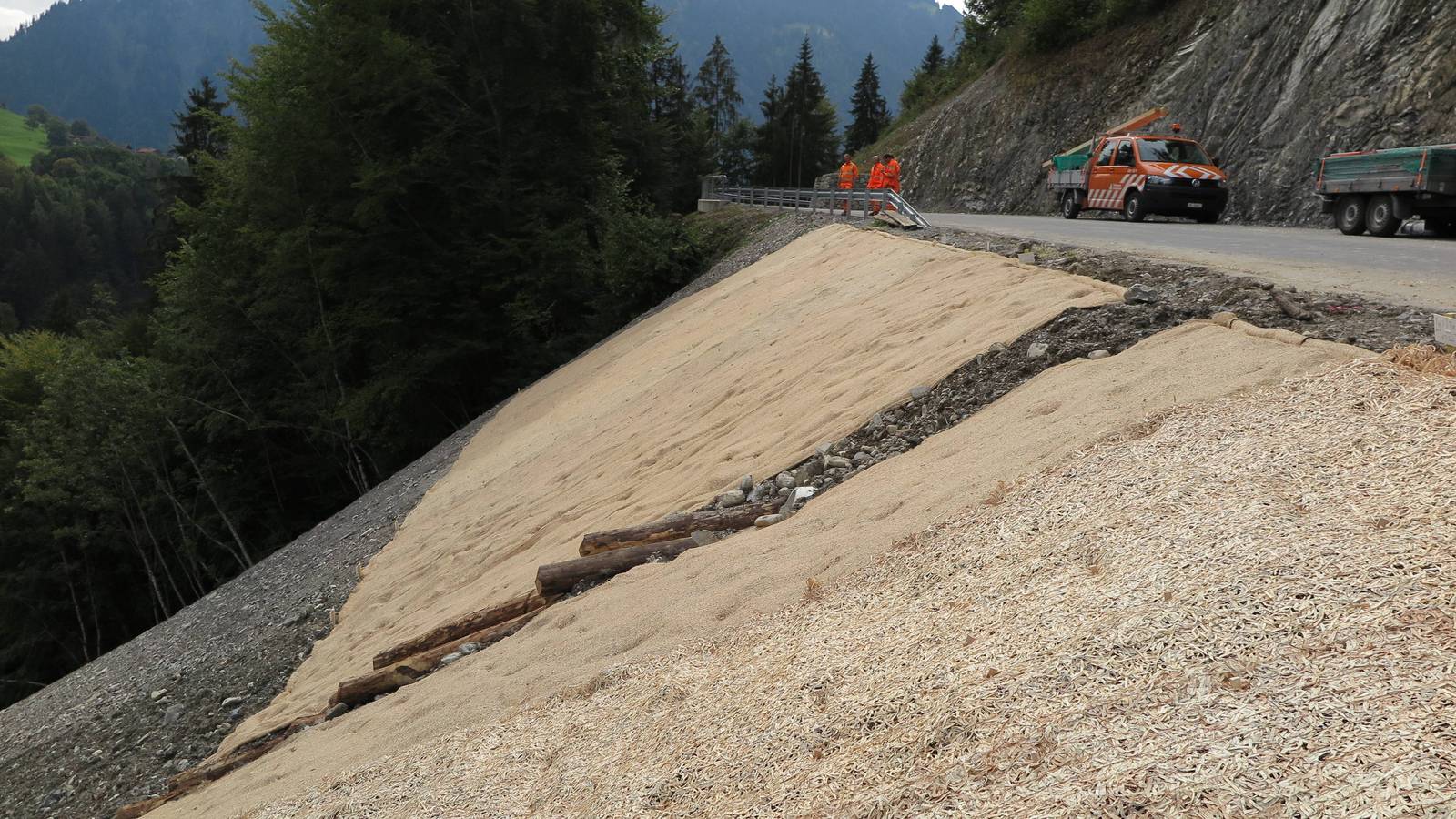
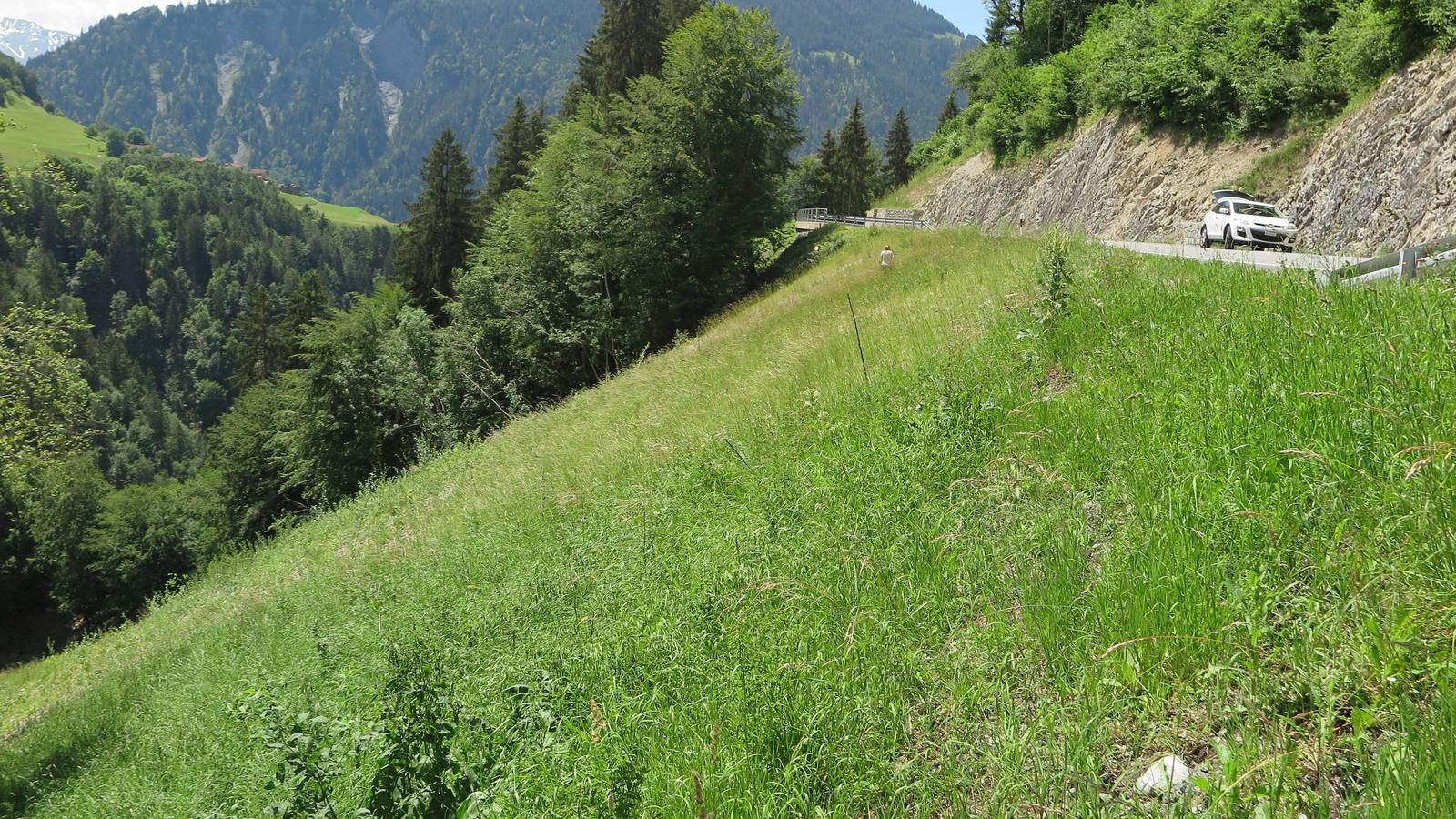
In the Innosuisse-funded research project, IBAR tested the effectiveness of Howolis products under real conditions. For this purpose, the test areas were covered with wood wool fleece and then planted with vegetation. The fleece stores surface water very well and promotes rapid plant growth. The resulting vegetation quickly forms a dense root system, which stabilizes the soil and significantly reduces slope erosion. While the plant cover develops, the wood wool also protects the subsoil from the eroding effects of rain and wind.
The suitability of Swiss wood wool for stabilizing slopes at risk of erosion was investigated. Four types of wood wool were used in combination with two seed mixtures on test areas of between 500 and 10,000 m². Different exposures and slope inclinations from 35° to 70° as well as very different soil conditions - from fertile topsoil to nutrient-poor gravel areas - were taken into account. A total of around 50,000 m² of wood wool fleece was installed for the project in the cantons of Graubünden, Ticino, Schwyz, Bern, Aargau and Zurich.
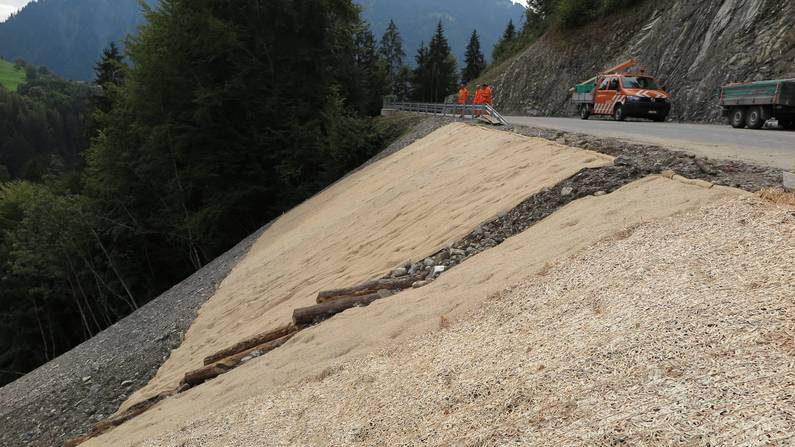
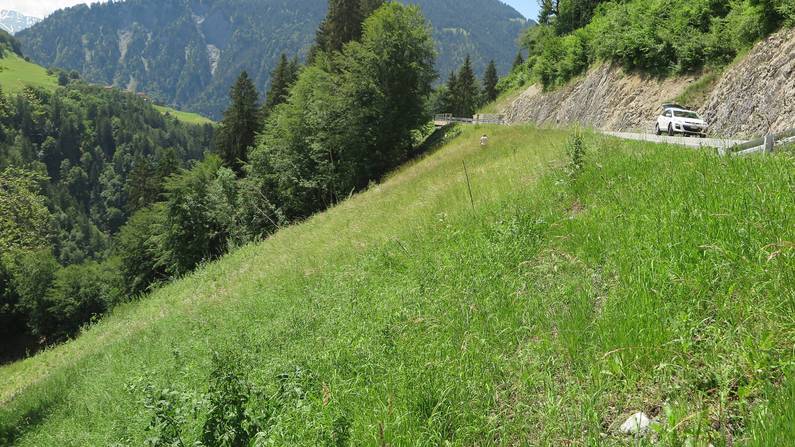
Wood wool fleece as erosion protection in Schiers GR: Installation on 15.09.2015, b: Greening status on 05.06.2018
Results
The test installation was continuously monitored and measured during the test period using laser scans. This was carried out by the Istituto Scienze della Terra (IST) of the research partner SUPSI (Scuola universitaria professionale della Svizzera Italiana) in Lugano. This provided insights into the influence of grammage, the durability of the different types of wood, changes in vegetation during the test period and the suitability of the substrate materials.
The project was completed in 2018. The results of the test areas were very different, mainly due to the widely varying site conditions. Factors such as exposure, slope inclination, soil quality, water and nutrient supply had a much greater impact on the success of the greening than the differences between the four types of wood wool. In the field, the nonwovens therefore showed a comparable effect, while clear differences in water absorption and tensile strength were visible in the laboratory.
Nevertheless, wood wool remains an effective, regional and sustainable geotextile that proved to be at least on a par with coconut or jute nonwovens in the field. Considering the sustainability of the product's origin and transportation, the wood wool fleece was clearly ahead. Where active erosion was already taking place or soil contact was lost, no vegetation was able to establish itself. Sunny and steep areas often remained bare, while shadier locations and more favorable soils produced better results. Nutrient-poor sites were still able to develop good vegetation if other conditions were suitable or fertilized hydroseeding was used.
Both seed mixtures led to a similar degree of greening, with HoloSem producing more species and locally typical plants. Damage caused by game also affected individual areas. Overall, it was found that the site factors had the greatest influence and overshadowed the differences between the wood wool types in the field.

The following former employee of the UAS Graubünden was involved in this project:
- Michael Heimgartner
Participants
The project is being implemented by the Institute for Building in the Alpine Region (IBAR) in collaboration with Lindner Suisse GmbH, SUPSI-IST and Ö+L. It is a project financed by Innosuisse (Commission for Technology and Innovation CTI).