Project at a Glance
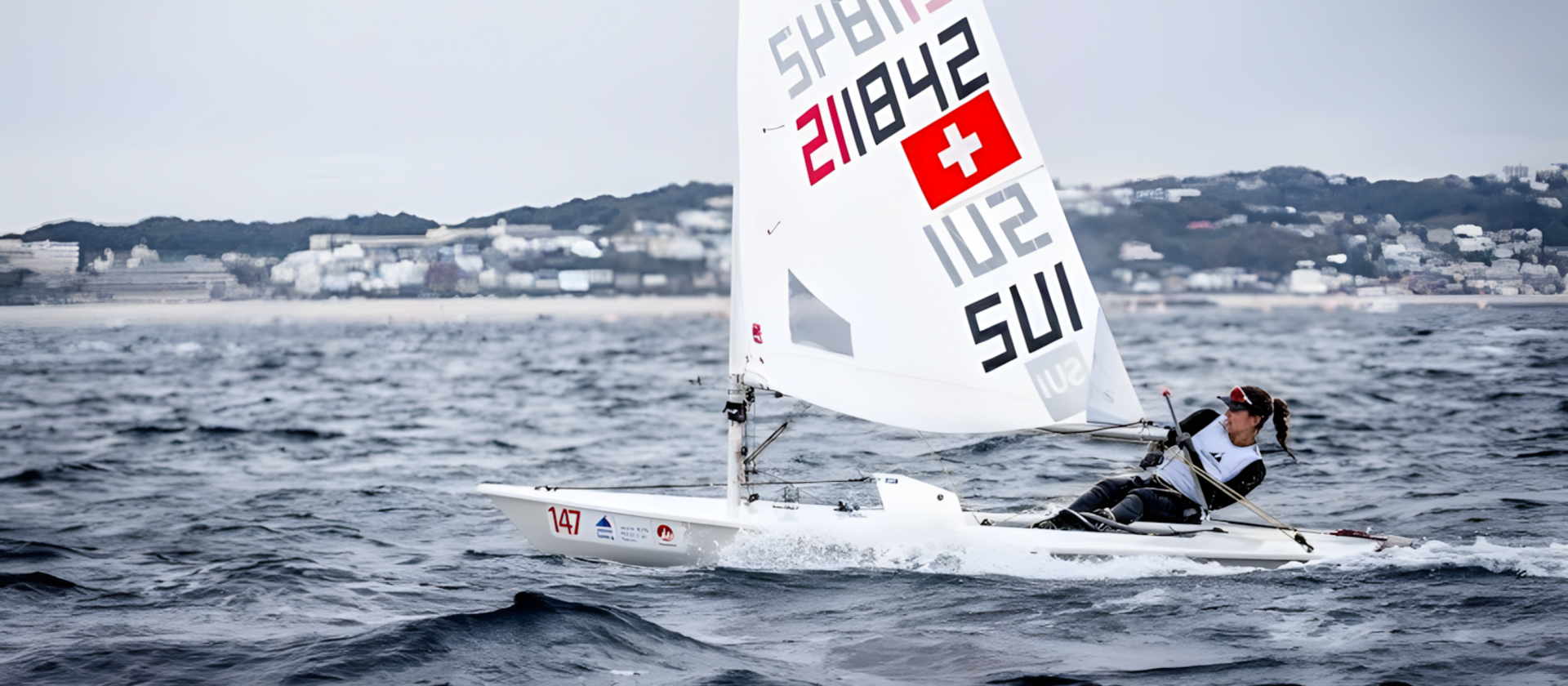
As in some sports such as skiing, cycling, kayaking, or even motorsports, route optimization is also a key element in sailing for improving performance and minimizing the time taken to cover a set race distance. To support Swiss sailors, this project is developing and testing a data-driven optimal routing tool based on rule-based AI.
Project
Optimal Routing for Swiss Sailors at the 2028 Olympics in Los AngelesLead
Institute for Data Analysis, Artificial Intelligence, Visualization, and Simulation (DAViS) More about Institute for Data Analysis, Artificial Intelligence, Visualization, and Simulation (DAViS)Involved parties
Swiss-Sailing
CNR, Institute for Computational Applications, Rome, ItalyResearch fields
AI for Structured and Unstructured Data More about AI for Structured and Unstructured Data Visualization and Dashboards More about Visualization and Dashboards
Background
In sailing, the time-optimization method of isochrone calculation is used to determine the shortest route. This process is carried out using the boat’s “polars” (speed as a function of wind speed and angle, waves, and currents) to calculate the shortest route based on wind conditions, sea state, and predicted, time-dependent ocean current data. This deterministic and parametric methodology is becoming increasingly reliable for open-water races as forecast models improve and the polars are refined.
Unfortunately, this methodology offers no advantage at the scale of Olympic sailing, since the highest spatial resolution of the forecast is comparable to the size of the race courses, and the finest temporal resolution is four times greater than the duration of the race. Furthermore, this highest resolution is already achieved through numerical downscaling methods from global models, which is why it deviates from reality and can produce a “garbage in—garbage out” effect.
Project Objectives
The goal is to develop a location-independent and scalable method to identify the robustness of optimal routes with respect to variable factors such as boat type, wind, waves, currents, and course geometry. This finding is crucial for race strategy.
In recent years, Swiss-Sailing has developed solid expertise in wind and current data analysis, including pattern recognition, and is confident that it is possible to reconstruct wind vector fields based on real-world data.
In the past, Swiss-Sailing has used equipped motorboats to measure wind and drift markers for currents. In this project, the intention is to create a data grid using the new generation of robotic instrument markers capable of measuring wind, waves, and currents.
All the mathematical methods and measuring instruments needed to achieve the goal of the research project (a collaboration between Swiss-Sailing, CNR, and the University of Applied Sciences of Graubünden) are available; the main challenges lie in the environmental conditions and the application of the method to Olympic sailing. The optimal routing tool developed is expected to be fully utilized during the preparations for the Olympic Games in Los Angeles and ultimately during the Games themselves.
Methods and Results
We have mapped the optimal routing problem—which can also be viewed as a decision problem—onto a high-dimensional, nonlinear optimization problem with numerous constraints. This approach incorporates measured, time-varying local wind data. A rule-based AI solves the optimization problem quickly and reliably. The identified optimal routes were validated by comparing them with GPS measurements of the routes taken by top athletes during competition.