Project at a Glance
Training elite alpine ski racers is costly, time-consuming, and heavily dependent on weather and snow conditions. In addition, there is always a risk of injury. The “Digital Wind Tunnel” project aims to transfer selected training elements from the snow to a simulator, thereby making training more efficient, safer, and available year-round. Aerodynamics play a crucial role, particularly in the speed disciplines of alpine ski racing. At top speeds of up to 155 km/h, even small improvements in body posture can lead to measurable performance gains.
Project
The “Digital Wind Tunnel” for Training Future Elite Alpine Ski RacersLead
Institute for Data Analytics, Visualization, and Simulation (DAViS) More about Institute for Data Analytics, Visualization, and Simulation (DAViS)Project Leader
Bünner Martin More about Bünner MartinInvolved parties
Swiss-Ski
University of Bern
Davos Sports High SchoolTeam
Barandun Joël More about Barandun JoëlResearch fields
Computational Science for Simulation and Optimization More about Computational Science for Simulation and Optimization AI for Structured and Unstructured Data More about AI for Structured and Unstructured Data
Project Goal
With the “digital wind tunnel,” Swiss-Ski can transfer selected training content from the snow to the digital wind tunnel, thereby making training more efficient, safer, and available year-round. Advantages of the digital wind tunnel:
More efficient training
- Year-round training regardless of weather or season
- No need to travel to and from the slopes
- More effective training time
Greater safety
- Reduced risk of injury
- Safe learning of optimal positions
Scientific support
- Objective performance metrics
- Standardized measurement protocols
- Automated analyses
Cost savings
- Less reliance on expensive wind tunnel tests
- Lower travel and training costs
- Early access for young athletes aged 15 and up
Long-term goals include:
- Introduction as a standard tool at Swiss-Ski’s three national youth training centers in Brig, Davos, and Engelberg
- Comparable performance evaluations
- Improved talent development and talent identification
- Scientifically grounded training throughout Switzerland
Implementation
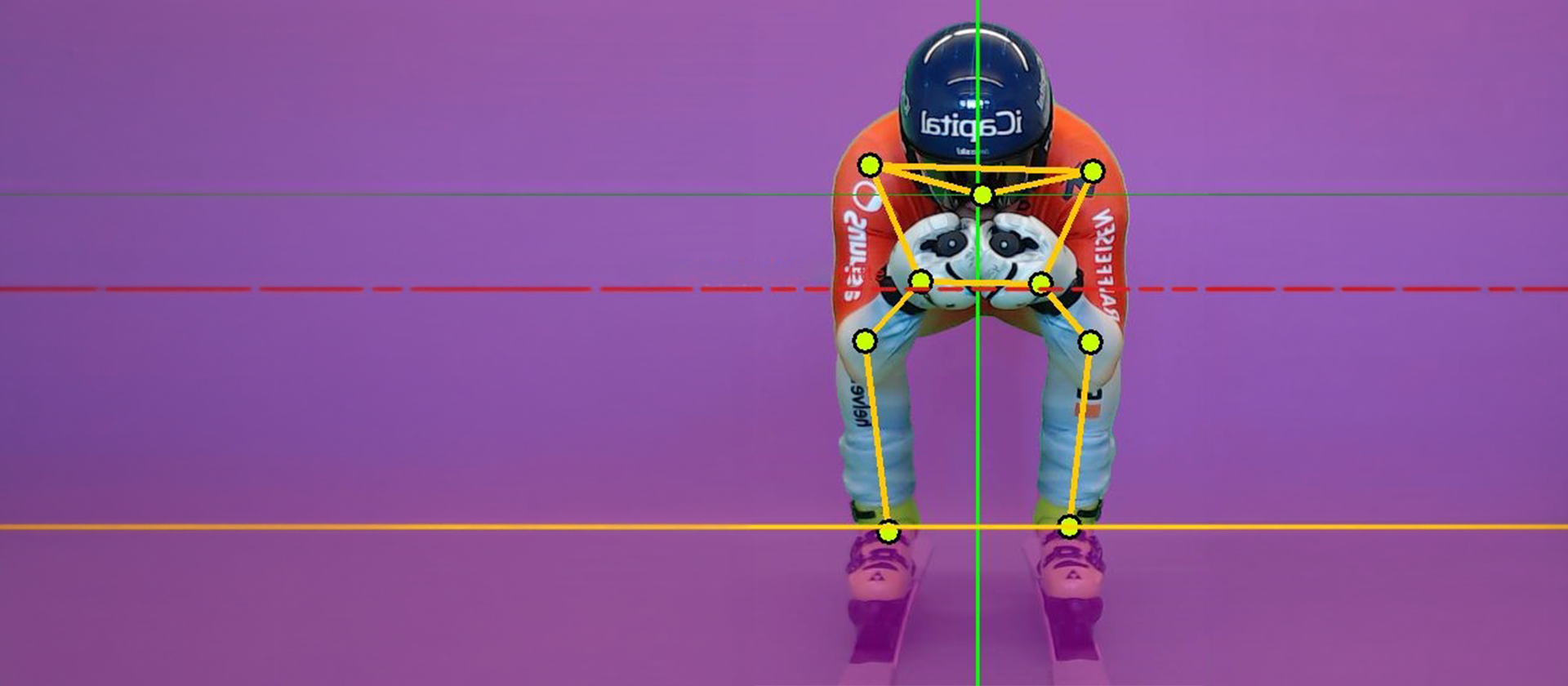
The digital wind tunnel combines:
- green-screen technology
- AI-powered pose estimation
- Real-time video analysis
- Dynamic simulation
Athletes receive immediate feedback on their aerodynamic position and can optimize it in a targeted manner.
Results
In a joint intervention study conducted with the University of Bern and the athletes and coaches of the Davos Sports High School, significant improvements in positional quality were observed as a result of training with the digital wind tunnel.