
At a glance
Thanks to the UAS Center (link only available in German) generation project, the UAS Graubünden will have a visible presence at the end of this strategy period. A university of applied sciences that works closely with stakeholders in the region, is known and recognized nationally as a university of applied sciences with clear specializations and has been able to establish its first international beacons.

In order to serve the economy and society, we are focusing on strengthening the core competence of higher education in the long term. We do this by further developing and redeveloping the courses we offer. We generate knowledge from research and practice, which we in turn pass on to our students.
Strategic goals
Promoting young talent
We focus on promoting the next generation of specialists and managers for the economy and society who design and successfully implement sustainable models and innovations. (Economy/Society)

Holistic problem solving
Our students learn to take a holistic approach to problems in a rapidly changing environment and to use their knowledge, practical skills and competencies to develop and implement future-oriented solutions to economically and socially relevant problems. (students)

Networked experts
Networked experts
We attract proven talents in teaching, research, organization and management and develop them into recognized, networked and internationally oriented experts. (Employees)
Attractive specializations
We are known for our attractive specializations and modern development-oriented teaching formats. (Teaching/Continuing Education)
Studying at the UAS Grisons

Application-oriented research
We are known nationally and internationally for our application-oriented research. (Research/Services)
Guiding themes

Governance/resources/communication
We live a quality-oriented, pragmatic and agile management, work and cooperation culture in all areas of life. We make optimum use of our financial resources within the framework of the funds made available to us in order to meet the demands placed on us in all service areas. At the same time, we ensure a good balance between administrative and personnel costs. We communicate our core messages to all our stakeholders.
University magazine "Wissensplatz" (link only available in German)

Development priorities
With the four development priorities, we take into account aspects from the coordination of higher education policy throughout Switzerland as well as the priorities from the 2025-2028 government program (link only available in German) and the cantonal higher education and research strategy (link only available in German).
Innovation driver
In our role as a driver of innovation, we want to contribute to reducing the shortage of skilled workers in technology and IT. With our focused research in technology and IT, we will develop central lighthouse projects and also promote the transfer of knowledge and technology through our role as a driver of innovation. We will also strengthen our leading position in the "Key Technologies" and "Computational Science" profile areas of the cantonal university and research strategy.
Guiding theme Applied Future Technologies
Economic development of Alpine regions
By focusing on the economic development of Alpine regions, we want to help alleviate the shortage of skilled workers and strengthen innovation in order to increase the competitiveness of companies in Alpine regions. The UAS Graubünden would also like to build on its leading role in tourism, and thus in the "Tourism and Economy" profile area of the cantonal university and research strategy, by expanding its networks. Our positioning in the economic disciplines is also to be further strengthened in order to tap into the exceptional potential of the Alpine region.
Guiding theme Entrepreneurial Management
Integrated supply of alpine regions
With the establishment of the Faculty of Health and a range of courses in the field of healthcare with the specifics of a sparsely and decentrally populated mountain canton, we want to directly counteract the shortage of specialists in the care sector. Further study and further education courses in the field of healthcare, together with research activities, contribute to the development of our new department.
Guiding theme Alpine Region Development
Increase in attractiveness
In order to meet the current and future needs of students in terms of infrastructure and study formats, we are taking strategic university and quality development measures in the areas of leadership, higher education, knowledge and technology transfer as well as resources and communication. Moving into the University of Applied Sciences Center in 2028 will also make an important contribution to increasing the attractiveness of our university.
University of Applied Sciences Center (link only available in German)
Cross-cutting issues
We position ourselves as an innovative, sustainable and open university that is dedicated to artificial intelligence, digitalization and diversity across disciplinary boundaries.
Innovation
Innovations are crucial to success. We understand this to mean the entire process, from the idea to market-ready implementation. Because only a successfully implemented idea on the market is an effective idea. In the innovation ecosystem, we see ourselves as a driver of innovation, especially for SMEs. Specifically, it is our graduates who bring innovation skills to companies, our research results, which provide an effective basis for further development, and our services for start-ups and established companies to build up expertise as part of knowledge and technology transfer.
Sustainable development
For us, sustainable development is a guiding principle for the development of the university as a whole. We base this on the 17 Sustainable Development Goals (SDGs) adopted by the United Nations. In our understanding, sustainable development is an integrated approach in management and support tasks as well as in the areas of knowledge and technology transfer, research & development, services and higher education. We do not act in isolation and one-dimensionally, but take into account the interactions between the environmental, economic and social dimensions.
Artificial intelligence and digitalization
Artificial intelligence is a relevant change and a major challenge for the economy and society, for which we want to implement solutions. Our practice-oriented research in artificial intelligence tackles social and economic challenges: from improving diagnostic procedures in healthcare to optimizing processes in industry. In our study and continuing education programmes, we impart sound theoretical knowledge and practical expertise in the application of artificial intelligence. In this way, we are preparing the next generation of AI experts for the future. We also promote digitalization along our processes in this cross-cutting topic.
AI and digitalization (link only available in German)
Diversity
We see measures to promote diversity not as a legal obligation, but as a great, future-oriented opportunity. We value the diversity that is expressed in personalities and skills, with their similarities and differences. We understand inclusion to mean that in the community of all university members, everyone can participate actively, equally and self-determinedly in activities and institutional development.
Open Science
Open Science stands for simplified access to scientific publications, data and content. By strategically anchoring Open Science, we promote better national and international visibility of research ("Open Access" and "Open Data") and teaching ("Open Educational Resources"). We are also strengthening collaboration both within the university and outside it through interdisciplinary cooperation. We also want to cultivate an appropriate and responsible approach to confidential or commercially valuable content and data, including in collaboration with the private sector in the context of applied research.
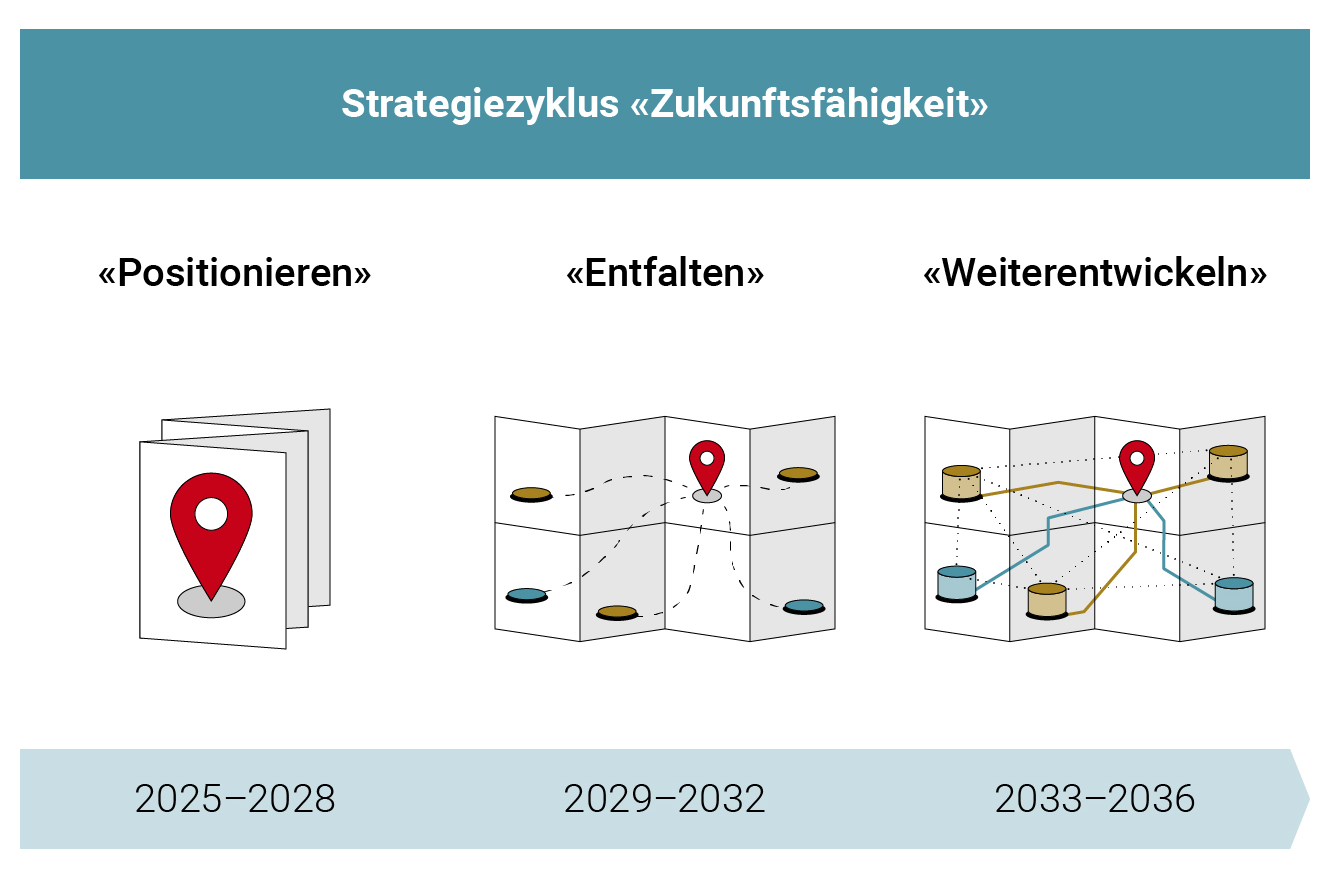
Strategy cycle
The past strategy cycle was characterized by the achievement of independence. Since then, the UAS Grisons has established itself as the eighth public university of applied sciences in Switzerland. Building on this foundation, we will devote ourselves to strengthening the competence of higher education in the coming years.
In the 'Future viability' strategy cycle (2025-2036), the focus will be on further developing the portfolio of education and research courses and, as a result, increasing the attractiveness of the university as a whole. This is also in view of the move to the new UAS center at the end of the 2025-2028 strategy period. Only in this way can the UAS Graubünden make its contribution to the further development of the canton and society.